STUN SMART

AI-driven Stunting Prevention & Early Intervention

Empowering communities and healthcare providers with advanced AI intelligence to monitor growth, predict stunting risks, and coordinate real-time nutrition interventions.

AI Growth Analytics

Uses machine learning algorithms to map and predict child growth curves based on WHO standards, flags anomalies instantly.

Personalized Intervention Plans

Generates custom nutrition recommendations and targeted health assistance packages for affected children.

Family & Community Collaboration

Connects local community health volunteers (Kader Posyandu), midwives, and families in a single collaborative loop.
https://stunsmart.indihealth.com/dashboard
STUN SMART AI Dashboard

System Overview

Smart Healthcare Dashboard is a web-based platform designed to assist healthcare workers in integrated stunting monitoring, analysis, prediction, and management. This system can be used by various stakeholders, from Posyandu volunteers, midwives, Puskesmas, to the Health Office in one single unified platform.

Core System Features

Discover the advanced features that power our stunting prevention ecosystem.

1. Dashboard Monitoring

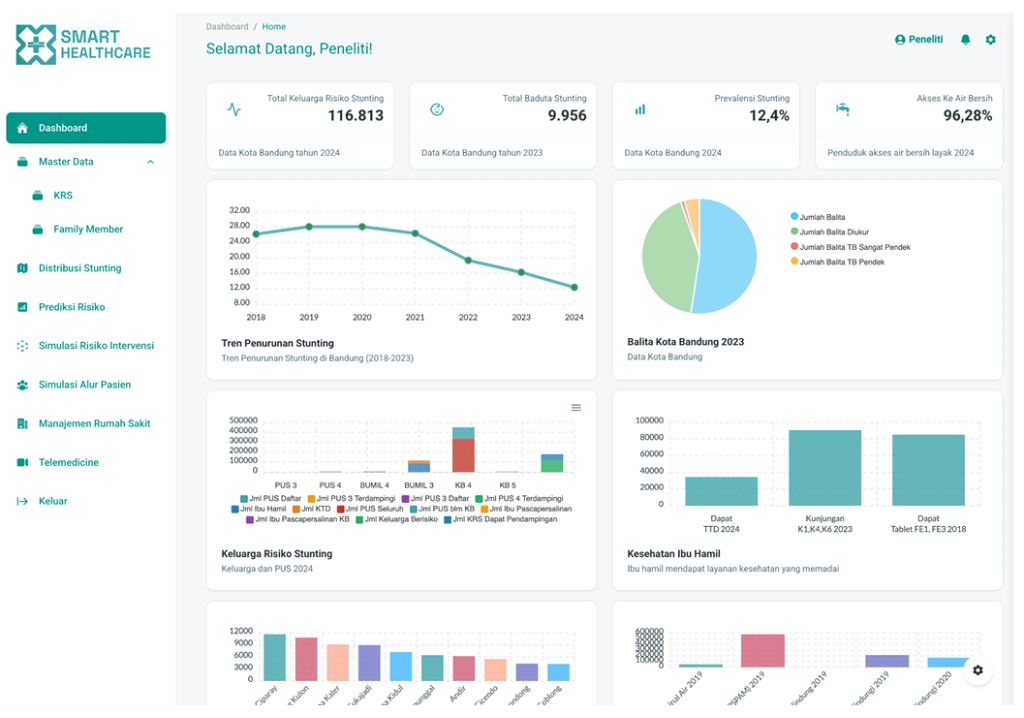
The dashboard displays critical stunting indicators in a single view, allowing users to quickly assess families at risk, stunting case counts, stunting prevalence, clean water access, and growth charts without leaving the page.

Key Advantages

  • Real-time information.
  • Easy to understand through charts.
  • Facilitates rapid decision-making.
Dashboard Monitoring

3. Stunting Distribution Based on GIS

The system displays stunting case distribution using an interactive map, allowing officers to identify high-risk regions immediately.

Key Advantages

  • Interactive map visualization.
  • Filter data by year.
  • Simplifies prioritization of intervention areas.
GIS Distribution

4. WHO Growth Standard Risk Prediction

This feature calculates a child's growth status based on age, gender, weight, and height using WHO standards (Z-score).

Key Advantages

  • Automatic calculation.
  • Fast and accurate results.
  • Assists healthcare workers in early screening.
WHO Risk Prediction

5. AI-Based Intervention Risk Simulation

The core system feature. Users input health, social, and economic conditions, and the system runs multiple Machine Learning models to predict stunting risk. In addition to risk level, it automatically suggests targeted interventions based on detected risk factors.

Key Advantages

  • Runs multiple AI models simultaneously.
  • Detects risk before physical symptoms appear.
  • Provides automated action recommendations.
  • Shows confidence level of predictions.
  • Includes intervention checklist and progress tracking.
AI Intervention Simulation

6. Patient Flow Simulation

Monitors the patient journey from registration to service completion.

Key Advantages

  • Real-time patient monitoring.
  • Prioritizes patients using color codes.
  • Helps reduce queues and identify service bottlenecks.
Patient Flow Simulation

7. Hospital Management

Helps hospital managers monitor operational health of the facility, including system connection status, bed availability, doctor schedules, and operational indicators.

Key Advantages

  • Real-time operational monitoring.
  • Facilitates coordination between units.
  • Quick assessment of hospital system health.
Hospital Management

8. Telemedicine

Enables patients to consult with doctors remotely without physically visiting the facility, supporting video calls, chat, and phone calls.

Key Advantages

  • Remote consultation.
  • Integrated with doctor schedules.
  • Supports consultation booking.
  • Expands access to healthcare services.
Telemedicine